

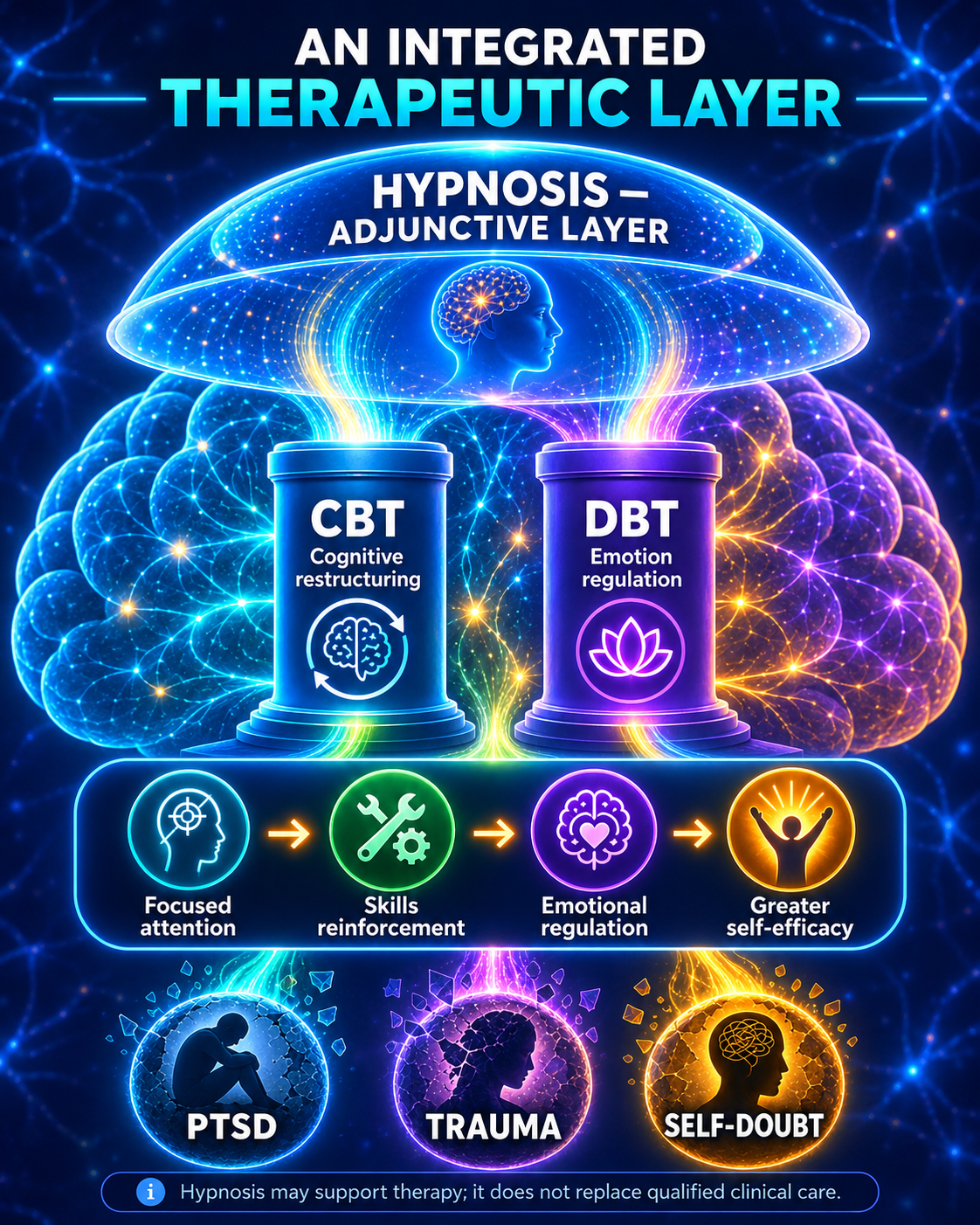
A pattern shows up often enough in clinical writing on trauma recovery that it deserves a proper explanation rather than a shrug: someone spends years in counselling, works seriously through Cognitive Behavioural Therapy, sometimes graduates to the more intensive skills of Dialectical Behaviour Therapy — and builds real, measurable capability.
They know the thought records. They know opposite action, distress tolerance, the whole DBT skills vocabulary. And it helps. And yet, for some people, something that looks almost quaint by comparison — a structured hypnosis session — produces a shift that feels different in kind, not just in degree.
That observation used to sit mostly in the territory of anecdote and stage-show scepticism. It doesn’t have to anymore. There is a real, growing, peer-reviewed literature on what hypnosis actually does to the brain, and it points to a specific, defensible answer for why it can work precisely because CBT and DBT came first — not despite it.
What Hypnosis Actually Is, Once You Strip the Theatre Away
Clinical hypnosis has nothing to do with swinging pocket watches or losing control of your will. The working definition researchers use is closer to this: a state of focused attention and absorption, guided by a practitioner, in which the mind’s usual background habit of monitoring, evaluating and second-guessing itself is deliberately turned down. You remain aware. You remain in control. What changes is how much effort your brain is spending watching itself think.
That description isn’t just clinical shorthand — it’s now something researchers can actually see.
The Brain Evidence: What Changes During Hypnosis
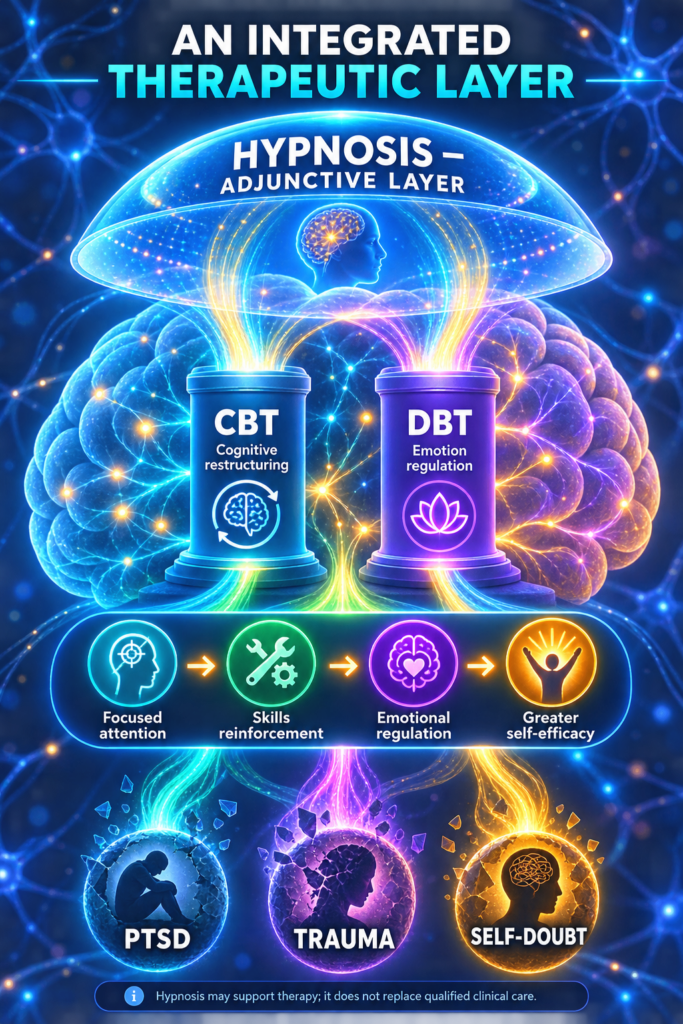
The most rigorous work here comes from David Spiegel’s team at Stanford, who used functional MRI to scan 57 people — some highly responsive to hypnosis, some not — across resting, memory-recall and hypnotic conditions. Published in Cerebral Cortex, the findings identified a distinctive, repeatable pattern in the brains of people under hypnosis: reduced activity in the dorsal anterior cingulate cortex, a region central to monitoring conflict and worrying about competing demands on attention, alongside a measurable change in how strongly the brain’s self-referential “default mode” network stays connected to the regions that actually plan and execute action.
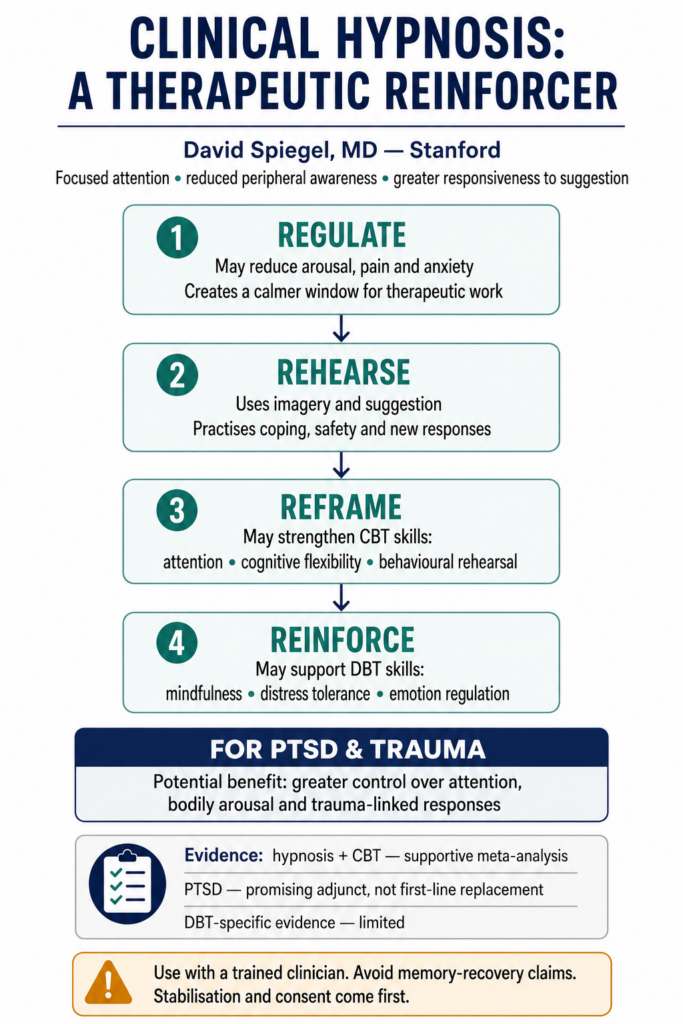
In plain terms: hypnosis appears to loosen the tight coupling between thinking about yourself and your problem and the part of the brain that has to act. A more recent integrative review extends this into an explicit neuroplasticity argument — that with repeated, well-structured hypnotic practice, this more flexible pattern of connectivity between the self-referential network and the executive-control network can persist beyond the session itself, gradually shifting someone’s baseline rather than only producing a temporary in-session state.
That is not a small claim, and it shouldn’t be waved through uncritically. Irving Kirsch, one of the most respected and genuinely sceptical researchers in this field, has spent decades arguing that much of what hypnosis produces can be explained by response expectancy — what you believe will happen strongly shapes what you actually experience, and that alone can account for a great deal of the placebo-adjacent territory hypnosis sits in. It’s a serious critique, and it hasn’t been dismissed by the neuroscience — sociocognitive researchers correctly point out that finding a distinctive brain state during hypnosis doesn’t, on its own, prove that state is doing the causal work. But it’s notable that Spiegel’s signature shows up specifically and consistently in people who test as highly hypnotisable, differs from simple memory recall or rest, and has now been replicated — which is a considerably higher bar than expectancy alone typically clears. The honest position is that both things are probably true at once: expectancy plays a real role, and there is also a measurable, non-trivial neural mechanism underneath it.
Why This Explains the CBT/DBT-Then-Hypnosis Pattern
Here is the mechanistic argument, stated plainly rather than mystically.
CBT and DBT work largely by building explicit, effortful cognitive skills: notice the thought, check it against the evidence, choose the opposite action, ride out the urge without acting on it. These are genuinely powerful tools, and they require the prefrontal, executive machinery of the brain — precisely the system that intense emotional arousal is well known to compromise. This is the well-documented cruelty of trauma and acute distress: the moment someone most needs their coping skills is often the moment their brain is least able to access them, because the emotional-arousal system has, in effect, taken the executive system temporarily offline.
If hypnosis’s real neurological effect is to loosen the grip of the self-monitoring, conflict-detecting network and change how tightly it’s coupled to the executive system, then it isn’t competing with CBT or DBT at all. It’s operating on a different layer of the same problem. CBT and DBT supply the content — what to actually do, thought by thought, urge by urge. Hypnosis, on this model, may work on the access pathway — how much effortful, conscious, worked-for control it takes to actually reach that content when it’s needed most. Skills that were previously effortful, conscious and easily overwhelmed under real emotional load may become more automatic, less effortful to reach.
That would also explain why the order matters. A structured hypnosis session offered to someone with no coping skills at all has little useful content to make more accessible. Offered to someone who has already spent months or years building genuine skills in therapy, it has real material to work with — the groundwork isn’t wasted preparation, it’s the actual substrate the mechanism operates on.
What the Outcome Data Actually Shows
The clinical evidence, where it exists in proper trial form, is genuinely strong for some populations:
– A 2016 meta-analysis in the Journal of Traumatic Stress pooling six studies and 391 participants found hypnotherapy produced a large, statistically significant reduction in PTSD symptoms (Cohen’s d of −1.18) — a big effect by the standards of behavioural-health research.
– A separate meta-analysis in the International Journal of Clinical and Experimental Hypnosis found manualised, structured hypnosis approaches produced an even larger effect on post-treatment outcomes (d = 1.17), which held up — and grew — at four-week follow-up (d = 1.58).
– The classic finding on hypnosis as a CBT adjunct, from Kirsch, Montgomery and Sapirstein’s meta-analysis, is now well cited for good reason: adding hypnosis to cognitive-behavioural treatment produced an average improvement 1.36 standard deviations greater than CBT alone — meaning the average patient getting both did better than roughly 90% of patients getting CBT by itself.
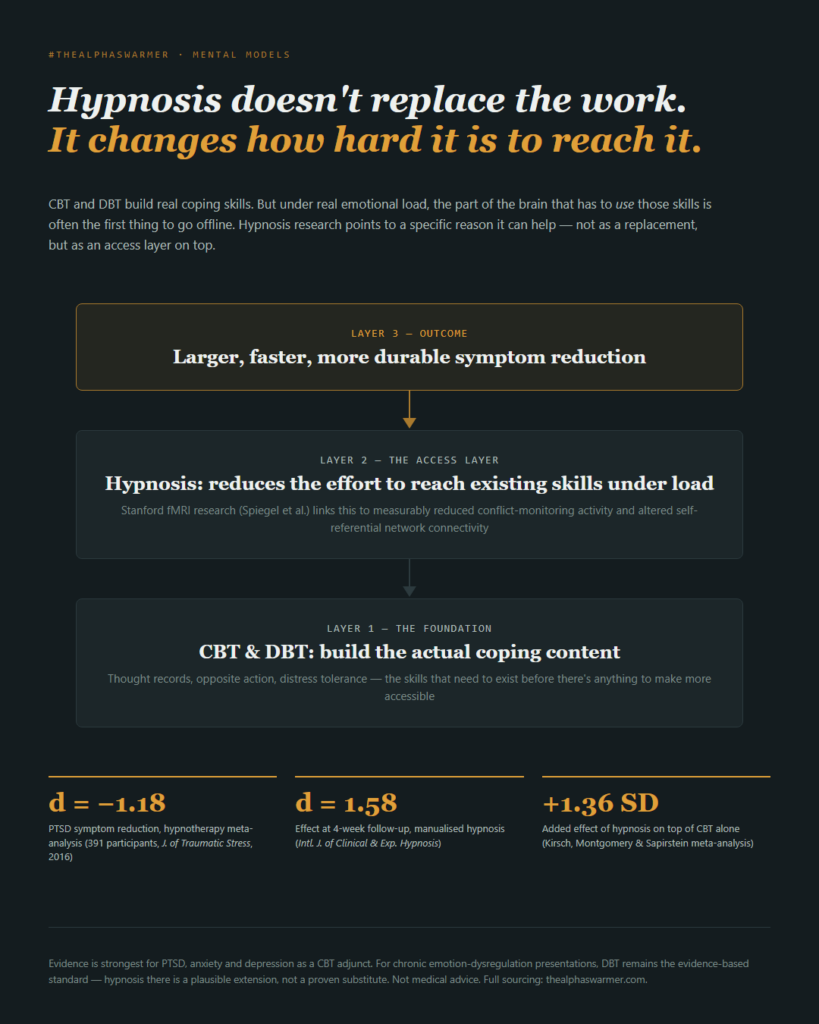
That’s a real, replicated, meaningfully large effect — not a hand-wave.
Where the evidence gets honestly thinner is the specific population this piece opened with: chronic emotional dysregulation and impulse control of the kind DBT was built to treat. There, the case for hypnosis is mostly clinical and anecdotal rather than backed by rigorous controlled trials — DBT itself remains the actual evidence-based standard of care for that presentation, and nothing here should be read as suggesting otherwise. The mechanistic argument above is a genuinely plausible reason hypnosis could extend DBT-trained skills. It is not the same as a body of trial evidence proving that it reliably does, for this specific population, at the scale the PTSD literature already has.
A Genuine, Correctly-Labelled Aside on DMT
One thread worth addressing honestly rather than glossing over: some readers will have encountered the idea of hypnosis alongside psychedelic research, particularly Rick Strassman’s well-known studies of intravenous DMT at the University of New Mexico in the early 1990s. To be precise about what that research actually was: it studied DMT administered on its own, not in combination with hypnotic induction — there is no documented study combining the two.
What is real, and genuinely interesting, is that hypnosis research and psychedelic research have arrived independently at a strikingly similar finding: both appear to suppress activity in the same default-mode network implicated in rigid, self-referential thinking, and both are associated with a loosening of the ordinary, effortful sense of monitoring and narrating one’s own experience. That’s a legitimate parallel about how the brain’s sense of self can be neurologically reorganised through more than one route — it just isn’t the same claim as “hypnosis under DMT,” and it shouldn’t be presented as such.
What This Actually Means, Practically
None of this makes hypnosis a replacement for trauma-focused first-line treatment, and it shouldn’t be marketed as one. The most defensible reading of the evidence is that hypnosis performs best as a genuine adjunct — most powerfully once the groundwork of safety, therapeutic alliance and real coping skills already exists, which is exactly the sequence this piece opened by describing. If you’re considering it, the practical advice that follows from the literature is unglamorous but important: work with a qualified clinical psychologist or psychiatrist trained in clinical hypnosis, not a general wellness practitioner with a weekend certificate, and treat it as one component of an overall treatment plan rather than a stand-alone fix.
This is scenario analysis and evidence synthesis, not a treatment recommendation, and it isn’t a substitute for professional medical or psychological advice from someone who actually knows your history.
References
Carhart-Harris, R.L. et al. (2012) ‘Neural correlates of the psychedelic state as determined by fMRI studies with psilocybin’, Proceedings of the National Academy of Sciences, 109(6), pp. 2138–2143. doi: 10.1073/pnas.1119598109.
Chetri, S. (2026) ‘Hypnosis as a mechanism of emotion regulation and self-integration: An integrative review of neural, cognitive, and experiential pathways to fundamental peace’, Behavioral Sciences, 16(3), Article 395. doi: 10.3390/bs16030395.
Jiang, H., White, M.P., Greicius, M.D., Waelde, L.C. and Spiegel, D. (2017) ‘Brain activity and functional connectivity associated with hypnosis’, Cerebral Cortex, 27(8), pp. 4083–4093. doi: 10.1093/cercor/bhw220.
Kirsch, I. (1985) ‘Response expectancy as a determinant of experience and behavior’, American Psychologist, 40(11), pp. 1189–1202.
Kirsch, I., Montgomery, G. and Sapirstein, G. (1995) ‘Hypnosis as an adjunct to cognitive-behavioral psychotherapy: A meta-analysis’, Journal of Consulting and Clinical Psychology, 63(2), pp. 214–220. doi: 10.1037/0022-006X.63.2.214.
O’Toole, S.K., Solomon, S.L. and Bergdahl, S.A. (2016) ‘A meta-analysis of hypnotherapeutic techniques in the treatment of PTSD symptoms’, Journal of Traumatic Stress, 29(1), pp. 97–100. doi: 10.1002/jts.22077.
Rotaru, T.-Ş. and Rusu, A. (2016) ‘A meta-analysis for the efficacy of hypnotherapy in alleviating PTSD symptoms’, International Journal of Clinical and Experimental Hypnosis, 64(1), pp. 116–136. doi: 10.1080/00207144.2015.1099406.
Strassman, R.J. and Qualls, C.R. (1994) ‘Dose-response study of N,N-dimethyltryptamine in humans: I. Neuroendocrine, autonomic, and cardiovascular effects’, Archives of General Psychiatry, 51(2), pp. 85–97. doi: 10.1001/archpsyc.1994.03950020009001.
Note: the Kirsch, Montgomery & Sapirstein (1995) effect size has drawn later methodological scrutiny over outlier sensitivity — some re-analyses report a more conservative ~70–75th-percentile equivalent rather than the ~90th-percentile figure implied by the raw 1.36 SD. Cited here as the original, most-referenced finding, with that caveat noted for full transparency.